
Entrepreneurship · Dell founder and direct-sales computing entrepreneur
Michael Dell Learned the Computer Business One Order at a Time
His breakthrough was not inventing the personal computer. It was redesigning the route between its components and its buyer.
How did Michael Dell succeed?
Michael Dell succeeded by selling computers directly to customers, configuring machines around actual demand, and reducing the costs and delays of traditional retail distribution. He began upgrading PCs while attending college, left school in 1984, and built an operating model in which customer information and inventory discipline reinforced each other.
The story
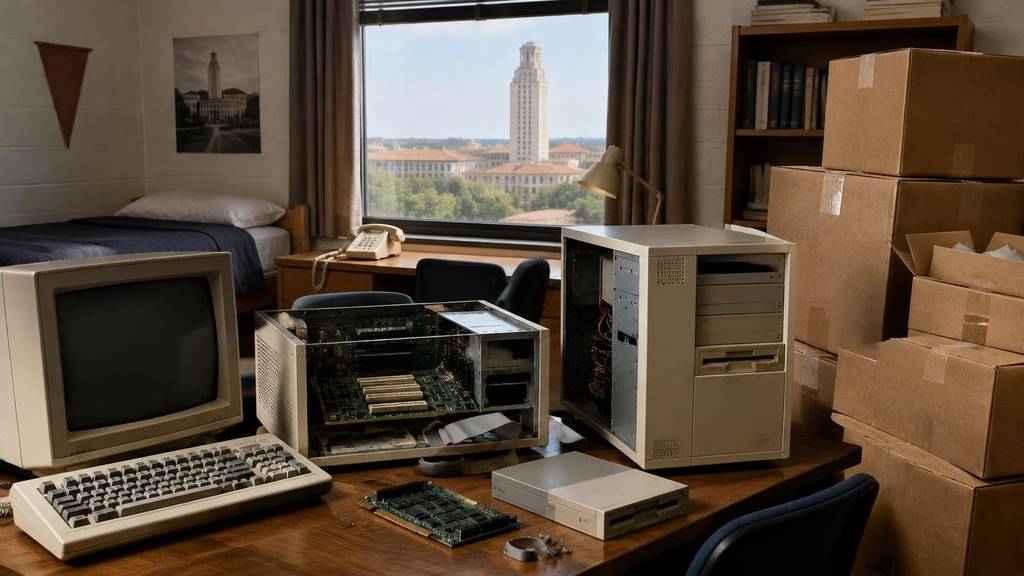
Michael Dell entered the University of Texas at Austin in 1983 as a premedical student, but computers were already competing for his attention. As a teenager, he had taken apart an Apple II to understand its workings and experimented with small commercial ventures. At university, he began upgrading personal computers and selling to customers who wanted more capability for their money. The dorm-room setting became famous later, but the important fact was the activity inside it: Dell was examining what buyers paid, what components cost, and how much value sat between those two numbers.
The personal-computer industry offered a timely opening. IBM-compatible machines were spreading, standardized components were increasingly available, and many buyers still purchased through distributors and retail stores. Each layer added cost while separating manufacturers from the people actually using the equipment. Dell saw that a customer could specify a desired configuration and buy more directly. He did not need to invent a processor or an operating system. He needed to assemble dependable machines, establish credibility, and show that avoiding parts of the conventional channel could create a better deal without making ownership feel unnecessarily risky.
In 1984, Dell registered his business as PC's Limited, starting with $1,000 in capital. He left university that year at age nineteen to pursue it full time. That decision followed evidence of demand rather than preceding all commercial activity. Orders and customer conversations gave the venture substance before the dramatic dropout moment. The business sold upgraded computers and then moved toward its own systems. Its 1985 Turbo PC, advertised at $795, offered an accessible example of the proposition: a competitively priced machine sold directly, with specifications that buyers could evaluate against more established alternatives.
Direct selling changed what the company could hear. A retailer might know which finished boxes moved off a shelf; Dell could hear which processor, memory configuration, or storage option a customer wanted before completing the machine. That information helped connect sales to procurement and assembly. Building around orders reduced the need to predict every configuration far in advance. It also created operational demands. Promised delivery dates, component availability, technical support, and product reliability had to align. The model was not simply cutting out a middleman. It was accepting responsibility for several jobs that the middleman had previously performed.
The company became Dell Computer Corporation in 1988 and went public that year. Growth brought customers whose needs differed from those of individual enthusiasts, including businesses buying fleets of machines. Those accounts required consistency, service, and purchasing relationships, not just an attractive advertisement. Dell's organization had to become skilled at repeatable execution. The founder's early habit of studying the economics of a single PC now had to extend to factories, suppliers, and working capital. What looked like a sales innovation from outside increasingly depended on coordination across the entire company.
The route was not perfectly straight. Dell experimented with retail distribution, then pulled back from that channel in the 1990s as its economics proved difficult. Inventory management also became a major focus after rapid growth exposed weaknesses. Component prices could fall quickly, turning excess stock into an expensive liability. A shorter interval between buying parts and shipping a finished machine therefore mattered financially as well as operationally. The company refined its direct model through these pressures. Its advantage came from making the system work under real conditions, not merely announcing that direct sales sounded more efficient.
Dell later expanded beyond the original PC formula. Michael Dell led a transaction that took the company private in 2013, and the business completed its acquisition of EMC in 2016, moving deeper into enterprise technology. Those later chapters were more complex than a dorm-room startup, but they continued to demand judgments about customers, capital, and distribution. His early example remains unusually practical for a self-taught founder: learn the product closely, locate an avoidable cost, sell before assumptions harden, and build an operation that improves as real customer information passes through it.
The Cheat Code: shortcuts that worked
1. Cheat Code: Price the Parts Inside the Box
Dell compared component costs with finished-PC prices. Break a familiar product into its economic parts to discover whether distribution, assembly, or configuration creates an opening.
2. Cheat Code: Let the Order Write the Specification
Dell's build-to-order approach connected customer requirements to production. Where feasible, obtain a real configuration choice or commitment before stocking every possible variation.
3. Cheat Code: Turn Sales Calls Into Demand Data
Direct customer contact revealed desired specifications without a retailer interpreting them. Record requests in a structured format that purchasing and production can actually use.
4. Cheat Code: Measure the Age of Every Part
Fast-changing computer components made stale inventory costly. Track how long money remains tied up in stock, not just the margin you hope to earn when it sells.
Your plan to do the same
- Pick a product category you understand and compare five retail prices with the costs of their major components or inputs.
- Interview five buyers about which specifications they value and which bundled features they would remove.
- Create three clearly priced configurations using parts or services you can reliably source.
- Seek one paid pilot order with an explicit delivery date before purchasing speculative inventory.
- Build a simple tracker linking each order to inputs, supplier lead times, cash paid, and customer payment.
- After delivery, ask the buyer what almost stopped the purchase and revise the ordering process around that answer.
Frequently asked questions
Did Michael Dell finish college?
No. Michael Dell attended the University of Texas at Austin and initially pursued premedical studies. He left in 1984, at nineteen, to run his growing computer business. His practical education came from upgrading machines, selling directly to customers, and learning the economics and logistics of computer production.
How much money did Michael Dell start with?
Dell established PC's Limited in 1984 with $1,000 in capital. The venture grew from his existing work upgrading and selling computers while at university. That small starting figure describes the initial business, not the total capital, supplier relationships, and infrastructure required as the company expanded.
What made Dell's direct-sales model different?
Dell sold directly to customers rather than relying primarily on traditional retail distribution. Buyers could choose configurations, and orders helped guide assembly and component purchasing. The model offered useful demand information and reduced some channel costs, but its success still depended on dependable delivery, service, and inventory control.