
Design · Architect and pioneer of organic architecture
Frank Lloyd Wright Learned Architecture in the Office
He left university without a degree, learned from Louis Sullivan, and turned the American house into a lifelong experiment.
How did Frank Lloyd Wright succeed?
Frank Lloyd Wright succeeded through office apprenticeship, independent experimentation, and a persuasive vision of architecture rooted in its surroundings. After leaving the University of Wisconsin without a degree, he learned in Chicago practices, especially Louis Sullivan's. His houses made that education visible through open plans, integrated details, and distinctive relationships with landscape.
The story
Frank Lloyd Wright's education began with more structure than the dropout legend suggests. Born in Wisconsin in 1867, he grew up with music, rural landscapes, and a mother who encouraged his interest in building. In 1885, he began studying at the University of Wisconsin while working for the engineering department. He left without completing a degree and moved to Chicago in 1887. That decision did not make him an architect overnight. It placed him inside a city rebuilding and expanding at extraordinary speed, where drawing ability and office experience could open a different route into the profession.
After early employment with Joseph Lyman Silsbee, Wright joined Adler and Sullivan in 1888. Louis Sullivan became his most important professional mentor. The office offered an education in actual commissions: drawings had to coordinate, clients had to be satisfied, and buildings had to stand. Sullivan's search for an architecture appropriate to modern American life gave Wright an intellectual direction as well as practical experience. Their relationship eventually broke down over Wright's outside residential work. In 1893, he established an independent practice. His emergence was therefore not a story of solitary invention, but of absorbed lessons followed by an increasingly forceful departure.
The house became Wright's primary laboratory. Working from Oak Park, Illinois, he challenged the Victorian preference for compartmentalized rooms and applied historical decoration. His Prairie houses emphasized horizontal lines, sheltering roofs, linked interior spaces, and a strong central hearth. The Ward W. Willits House of 1901 and the Frederick C. Robie House of 1908–1910 made those ambitions tangible. Windows, furniture, built-in storage, and circulation belonged to the same composition. A commission was not simply a container to decorate after the plan was complete; it was an opportunity to coordinate the experience of living at multiple scales.
Wright also understood that drawings could carry an architectural argument beyond a building's address. The Wasmuth portfolio, published in Germany in 1910, introduced his work to an influential European audience. Yet his personal and professional life was far from a smooth ascent. In 1914, an employee murdered seven people at Taliesin, including Wright's companion Mamah Borthwick, and set fire to the residential quarters. Wright rebuilt. The catastrophe should not be reduced to a productivity lesson; it was a profound human loss. His continued work unfolded amid grief, financial difficulties, public controversy, and the complicated consequences of his own decisions.
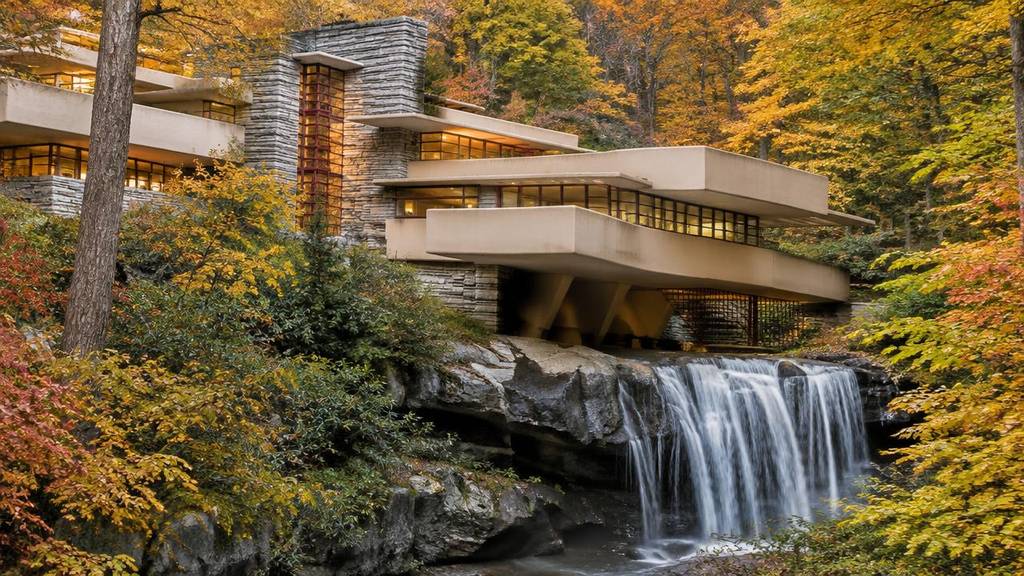
In 1932, Wright and his wife, Olgivanna, established the Taliesin Fellowship, organizing architectural education around communal life and practical work. A remarkable late-career revival followed. Fallingwater, designed in 1935 for the Kaufmann family, projected reinforced-concrete terraces over a Pennsylvania waterfall rather than positioning the house at a detached viewpoint. The first Jacobs House, completed in Madison in 1937, pursued a different ambition: a compact, comparatively economical dwelling associated with his Usonian program. These projects show that his method was not one fixed appearance. He repeatedly reconsidered how structure, budget, site, and domestic routine might generate an architectural whole.
Wright died in 1959, the year New York's Solomon R. Guggenheim Museum opened. Its spiral ramp extended his resistance to conventional room arrangements into a public institution. His career also left cautionary evidence: celebrated buildings could have leaks, structural problems, or demanding maintenance requirements. Originality did not cancel technical responsibility. What made his unconventional education consequential was the scale and persistence of its application. He learned from a mentor, articulated a position, tested it in buildings, and kept revising the problem. His achievement belongs to that long chain of practice, not to the absence of a university credential by itself.
The Cheat Code: shortcuts that worked
1. Cheat Code: Apprentice to a Point of View
Study how Sullivan joined architectural principles to office practice. Seek a mentor whose decisions you can observe, not merely whose reputation you admire.
2. Cheat Code: Start at the Hearth
Use a central gathering place to organize a house before dividing it into named rooms.
3. Cheat Code: Draw Past the Building Shell
Carry a single geometric idea through windows, built-ins, furniture, and circulation, as Wright did in his integrated interiors.
4. Cheat Code: Publish the Architectural Argument
Prepare drawings that explain relationships and spatial sequence, taking the Wasmuth portfolio as a model of design communication.
Your plan to do the same
- Compare a conventional nineteenth-century house plan with the Robie House plan.
- Diagram how the hearth, entrance, and principal living spaces relate in a Prairie house.
- Work with an experienced designer on a real drawing package and track every correction.
- Design one built-in element that reinforces the geometry of its room.
- Develop two schemes for a landscape site: one overlooking its main feature and one engaging it directly.
- Present your scheme alongside a candid review of structure, waterproofing, cost, and maintenance.
Frequently asked questions
Did Frank Lloyd Wright have an architecture degree?
Wright did not earn an architecture degree. He studied at the University of Wisconsin without graduating, then learned through employment in Chicago architectural offices. His most influential professional education came under Louis Sullivan. Describing him as entirely untrained overlooks both his university exposure and his substantial apprenticeship.
How did Louis Sullivan influence Frank Lloyd Wright?
Sullivan gave Wright experience inside a major architectural practice and encouraged the search for a distinctly modern American architecture. Wright worked at Adler and Sullivan before opening his own office in 1893. He later developed an independent approach, especially in houses, while continuing to acknowledge Sullivan's importance.
What made Fallingwater different from other houses?
Designed in 1935, Fallingwater placed the Kaufmann family's house over a waterfall using projecting reinforced-concrete terraces. Wright made the stream, rock, sound, and forest part of the domestic experience. Its distinction lies in that integration, although its ambitious structure also required significant conservation and engineering work.